
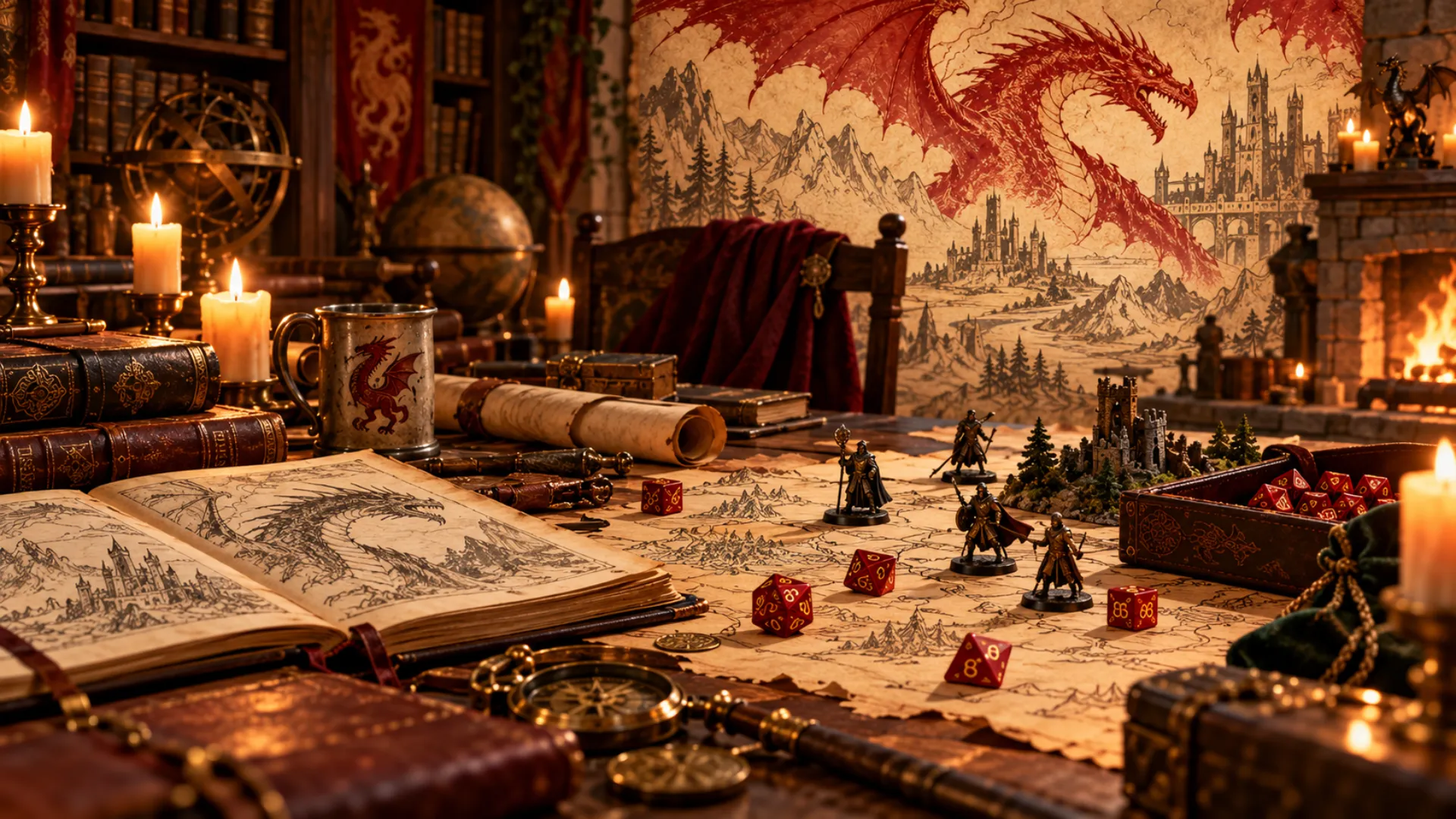
Tabletop roleplaying games create stories through conversation, decisions, and agreed rules rather than through a fixed sequence of events. A typical gaming group includes players who portray fictional characters and a game master who describes situations and interprets the fictional world. Players explain what their characters attempt, while the game’s rules help determine outcomes when success is uncertain. The resulting narrative cannot be completely predicted before a session begins because every participant can influence what happens next. This combination of structure and improvisation distinguishes tabletop roleplaying from conventional board games and many other forms of storytelling.
The development of tabletop RPGs is closely connected to the history of fantasy literature, miniature wargaming, and collaborative entertainment. Early roleplaying games established systems that allowed individual characters to develop through continuing adventures rather than isolated competitions. Over time, designers introduced different approaches to character abilities, storytelling responsibilities, and the resolution of fictional conflicts. Some games emphasize tactical challenges, while others place greater importance on relationships, investigation, or narrative development. Despite these differences, the interaction between participants remains central to the experience of creating a shared story.
The Difference Between Written Stories and Roleplaying Adventures
Traditional fiction presents events that have been selected and arranged by an author. Readers may interpret characters and themes differently, but their interpretations do not ordinarily change the events printed in the book. Tabletop roleplaying introduces a different relationship between the audience and the fictional world because participants become active decision-makers. A player might negotiate with an opponent, investigate a mysterious location, or avoid a confrontation that the game master expected to occur. These decisions influence the direction of the adventure and may produce consequences that were not planned in advance.
This difference does not mean that tabletop campaigns lack preparation or narrative structure. Game masters frequently develop locations, supporting characters, conflicts, and background information before a session begins. Published adventures can also provide detailed scenarios, including maps, encounters, and possible developments. However, the players’ decisions influence how these prepared elements are encountered and resolved during play. A successful campaign therefore combines useful preparation with enough flexibility to accommodate unexpected actions.
The interactive nature of roleplaying also changes the way fictional characters are understood. Instead of following a character whose choices have already been established by an author, players make decisions from the perspective of characters they portray. Those decisions may reflect the character’s goals, established personality, or response to changing circumstances. As sessions continue, a character’s history develops through both intended actions and unforeseen consequences. This gradual development helps explain why long-running characters can become important parts of a group’s shared memories.
The Influence of Wargaming on Early Roleplaying Systems
Modern tabletop roleplaying developed partly from traditions established by miniature wargaming. Wargames commonly used maps, models, measurements, and rules to represent military conflicts or imaginary battles. During the early 1970s, experiments with these systems helped create opportunities for participants to control individual characters rather than entire armies. Dungeons & Dragons, created by Gary Gygax and Dave Arneson and first published in 1974, became a foundational example of this approach. Its rules combined combat procedures with character advancement, exploration, and the interpretation of imaginary situations.
The shift from commanding armies to portraying individual adventurers changed the kinds of experiences that a game could represent. Characters could enter fictional buildings, interact with inhabitants, acquire equipment, and make choices unrelated to combat. A continuing campaign allowed events from previous sessions to influence later adventures, introducing a stronger sense of character history. Game referees were responsible for interpreting situations that written rules did not necessarily anticipate. This flexibility became an important feature of the emerging tabletop roleplaying format.
Early roleplaying rules also influenced how later games organized character development and uncertainty. Numerical attributes, character abilities, experience systems, and dice-based procedures provided ways to represent actions within a consistent framework. Different designers subsequently adapted or replaced these mechanisms to accommodate other fictional genres and styles of play. Science fiction, horror, historical settings, and investigative mysteries all became subjects of tabletop RPGs. The resulting variety demonstrates how the basic idea of portraying fictional characters could function beyond its original fantasy gaming context.
How Rules and Dice Influence a Shared Narrative
Rules provide a common framework for deciding what characters can accomplish within a fictional setting. In many tabletop RPGs, a character’s attributes and abilities help determine the likelihood of succeeding at a difficult action. Dice introduce uncertainty, preventing every challenge from being resolved solely by the wishes of a player or game master. Modern editions of Dungeons & Dragons frequently use a twenty-sided die to resolve attacks, ability checks, and saving throws. Other roleplaying systems may use different dice, cards, numerical comparisons, or alternative resolution methods.
Random outcomes can create dramatic situations because a carefully planned action is not guaranteed to succeed. A character attempting to cross a dangerous bridge might encounter difficulties that alter the group’s immediate priorities. A failed attempt to persuade a fictional opponent could lead to negotiation, retreat, or a different approach to the problem. The rules establish how uncertainty is handled, but the players and game master interpret what the resulting events mean within the story. In this way, mechanical procedures can contribute to narrative development without determining every detail of the plot.
Not every tabletop roleplaying game gives the same importance to chance or numerical complexity. Some systems rely heavily on detailed combat procedures and tactical positioning, while others use simpler mechanics that concentrate on character relationships or storytelling choices. The design of a game’s rules affects the activities that participants are encouraged to pursue. A system with extensive exploration procedures may produce different experiences from one built around interpersonal conflict or investigation. Understanding these design differences helps explain the wide range of storytelling methods available within tabletop gaming.
The Role of Worldbuilding in Collaborative Adventures
Worldbuilding establishes the environments, institutions, and historical circumstances in which fictional adventures take place. A campaign setting may include settlements, political organizations, geographical regions, religions, and forms of technology or magic. These details provide context for the decisions made by characters and help participants understand the consequences of their actions. Fantasy literature offers numerous examples of carefully developed imaginary worlds, but tabletop settings must also respond to decisions made during play. As a result, a roleplaying environment often develops through continuing interaction between preparation and improvisation.
An effective campaign world does not require every location or historical event to be described before the first session. Game masters can begin with a limited setting and introduce additional details as characters travel or investigate new situations. A small village might provide the starting point for adventures involving nearby ruins, unfamiliar travelers, and local disagreements. The wider history of the setting can become relevant when the characters encounter evidence of earlier conflicts or meet people with different perspectives. This gradual approach allows worldbuilding to develop alongside the needs of the campaign.
Consistency is important because participants need to understand how the fictional environment responds to their actions. If a settlement has established customs or laws, those details can influence interactions with its inhabitants. Similarly, geographical distances, available resources, and previous events may affect what characters can reasonably accomplish. The game master can revise or expand the setting, but changes are easier to understand when they follow recognizable explanations within the fictional world. A consistent environment makes players’ decisions more meaningful because their consequences can be connected to information established during earlier sessions.
Why Campaign Records and Gaming Memories Matter
A tabletop campaign produces more than the immediate experience of playing a game. Character sheets, maps, written notes, and adventure summaries can preserve information about events that occurred during previous sessions. These records help participants remember important decisions, unresolved conflicts, and relationships between fictional characters. In long-running campaigns, written documentation can also prevent inconsistencies when the story becomes increasingly complex. Recording events is particularly useful when a gaming group meets irregularly or returns to a campaign after an extended break.
Campaign records also have a broader significance for understanding the social history of tabletop gaming. Published rules explain how a game was designed to function, but they do not necessarily reveal how particular groups used those rules. Personal accounts can describe house rules, preferred settings, local gaming traditions, and the practical arrangements involved in organizing sessions. These details demonstrate that roleplaying culture has never been defined exclusively by the contents of official publications. The experiences of individual groups provide additional context for understanding how tabletop games developed in everyday settings.
The preservation of gaming history benefits from distinguishing contemporary records from memories written many years later. A dated character sheet or campaign notebook may establish what information a group recorded at a particular time. A later recollection can explain why the experience was memorable, although some details may have changed through the process of remembering. Neither type of material provides a complete historical account on its own. Considering different forms of evidence together can produce a clearer understanding of how games were experienced, adapted, and discussed.
The Continuing Value of Collaborative Storytelling
Tabletop roleplaying remains a distinctive form of creative participation because the story develops through decisions shared among several people. Published adventures and established rules provide structure, but the participants determine how those materials become an actual gaming experience. A campaign may involve strategic problem-solving, fictional relationships, exploration, or the interpretation of unusual events. Different groups can use the same game system and setting while producing substantially different stories. This variation is a natural result of allowing human decisions to influence the narrative.
The history of roleplaying demonstrates that imaginative play can be organized through many different systems and traditions. What began as experiments connected to miniature wargaming developed into a broad category of games representing numerous fictional genres. The continued production of rulebooks, settings, and adventures reflects the adaptability of the roleplaying format. Equally important are the informal practices through which participants create characters, document events, and establish their own gaming traditions. Understanding both published material and personal experience provides a fuller picture of collaborative storytelling as a cultural activity.